
What is an EPM specialist, and why are they so hard to find?
Most businesses know what their ERP partner does. They probably have someone looking after business intelligence and reporting too.
But who helps finance connect the dots between what has happened, why it happened, what comes next and what the business needs to do about it?
That's where an Enterprise Performance Management (EPM) specialist comes in.
At Pivot2, EPM is all we do. And one thing we've learned is that finding someone who genuinely understands both the finance and the technology is harder than you might think.

EPM is much more than budgeting and forecasting
When people hear EPM, they often think about budgets, forecasts and financial models. And while planning is a big part of it, EPM covers much more of the finance function.
It includes:
Planning, budgeting and forecasting: Building financial and operational plans, modelling scenarios and understanding the impact of business decisions.
Financial consolidation and close: Bringing together financial results across entities, currencies and complex ownership structures, including eliminations and adjustments.
Account reconciliation and transaction matching: Automating reconciliations, identifying discrepancies and improving confidence in the numbers.
Profitability and cost management: Understanding where the business makes money, how costs are allocated and what's driving margins.
Financial and management reporting: Delivering consistent, governed reporting for management, boards and external stakeholders.
These aren't isolated activities. They're connected parts of how a business manages its financial performance.
A forecast is only useful if the opening financial position is right. A consolidated result needs to be trusted before it can inform decisions. And management reporting needs to tell the same financial story as the underlying numbers.
Good EPM connects these processes rather than treating them as separate finance exercises.
Where does EPM fit alongside ERP and BI?
ERP, EPM and Business Intelligence (BI) each play an important role, but they solve different problems.
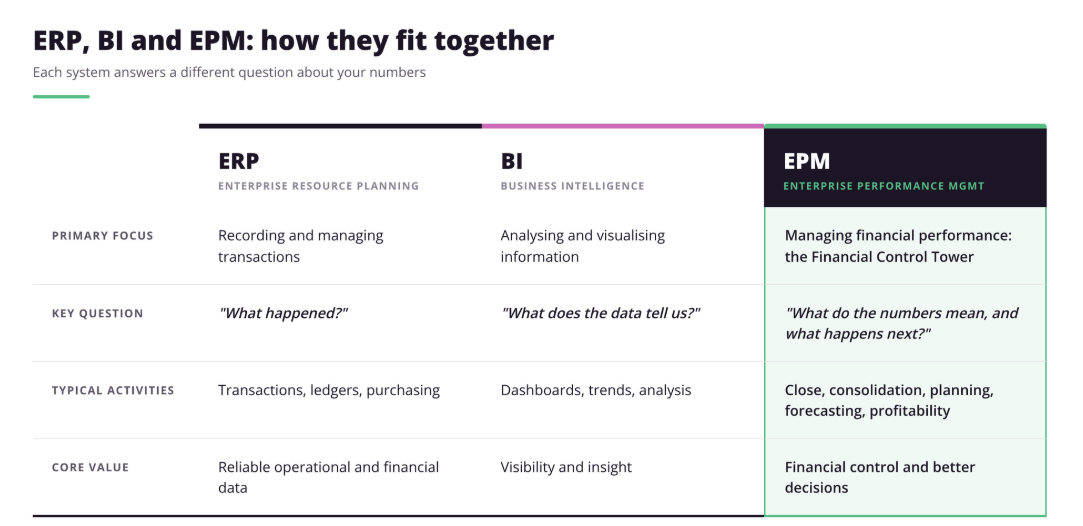
“The boundaries aren't absolute. Modern ERP systems have reporting capabilities, BI tools can support forecasting, and EPM platforms provide sophisticated analytics”.
The difference is the depth of financial processes and business logic each is designed to support.
An EPM specialist understands how those systems need to work together, rather than trying to make one platform do everything.
Why is a good EPM specialist so hard to find?
This is where the role becomes particularly interesting.
Most consultants come from one of two backgrounds. They're either finance people who have developed technical skills, or technical people who have learned about finance.
Both can become excellent EPM consultants. But being genuinely strong across both disciplines takes time, experience and a particular way of thinking.
Understanding finance
An EPM specialist needs to be comfortable talking to a CFO about financial statements, working capital, consolidation, intercompany eliminations, allocations and the month-end close.
They need to understand why the numbers matter, not simply where they sit in a system.
Understanding technology
They also need to know how to translate those requirements into a working solution.
That means understanding multidimensional data structures, calculation logic, integrations, automation, security, performance and how changes in one part of a model affect everything else.
Understanding the business
And there's a third skill that's just as important.
They need to understand how the business actually operates.
A university doesn't plan revenue the same way a retailer does. A construction business has different financial drivers from a professional services firm. A not-for-profit needs to understand funding restrictions in ways that a commercial organisation may never encounter.
The consultant has to get beneath the financial statements and understand the operational drivers that produce them.
It's this combination of finance, technology and commercial understanding that makes a great EPM specialist relatively rare.
A technically perfect model that doesn't reflect how the business works isn't a successful outcome. Neither is a beautifully designed finance process that the technology can't support efficiently.
The real skill is making both work together.
What does that look like in practice?
One of the things we enjoy most at Pivot2 is the variety of businesses we get to work with.
Our consultants don't just learn another system. They have to learn how an entirely different business operates.
For example:
Higher education: Understanding how student enrolments translate into student load, funding and revenue across thousands of courses and programs.
Franchising: Modelling how store openings, closures and franchise conversions affect royalties, supply revenue and marketing funds across a large network.
Hospitality: Understanding venue profitability, weekly trading patterns and the impact of casual labour and penalty rates.
Live events: Connecting attendance forecasts, ticket revenue, spending per head and event staffing to financial outcomes.
Not-for-profit: Planning funded positions and vacancies, managing grant restrictions and allocating shared costs appropriately.
Energy and infrastructure: Linking capital investment to depreciation, cash flow, financing requirements and financial reporting.
Global organisations: Managing complex entity structures, currencies, local planning requirements and consolidated financial results.
And outside planning, the challenges can be just as complex.
An EPM specialist might be working through why intercompany balances aren't eliminating correctly, designing automated reconciliations across multiple systems, or helping a finance team shorten its close without compromising financial controls.
These are very different problems, but they require the same combination of financial knowledge, technical capability and an understanding of the business.
That's what makes EPM consulting interesting. You're not just implementing software. You're translating how a business works into financial processes and technology that people can trust.
Why the best EPM specialists don't just build what they're asked for
There's another important distinction between someone who knows the software and someone who really understands EPM.
A good EPM specialist doesn't automatically build what the client asks for.
They ask why.
Why is that reconciliation done manually? Why does the forecast need that level of detail? Why are those allocations calculated differently across departments? Why does finance maintain three versions of the same report?
Sometimes the answer is a technical limitation. Sometimes it's a legacy process that's been around for years. And sometimes the business simply hasn't had the opportunity to rethink how things could work.
But asking why is only half the job. Anyone can point out what's wrong with a process. The real value of a specialist is what comes next: designing something better, and then building it.
That means simplifying processes that have become complicated over time. Standardising how things are done across entities and departments. Retiring the workarounds, duplicate reports and alternative hierarchies that only exist because "that's how we've always done it".
It's the difference between replicating an existing spreadsheet in a new system and genuinely improving how finance operates.
And with AI, that difference matters more than ever.
Why this matters even more with AI
AI is creating some exciting opportunities across finance.
From explaining variances and generating commentary to identifying anomalies, supporting forecasts and accelerating analysis, there's enormous potential.
But AI doesn't remove the need to understand the underlying financial logic, and it won't fix a complicated model on its own.
If your model is full of legacy processes, manual workarounds and alternative hierarchies maintained purely for reporting, tools like Claude and ChatGPT have to work much harder to interrogate and understand your data. The answers come back slower and with less confidence.
That's why the challenge-and-simplify work is so important. A specialist who reviews what you're doing and how you're doing it, questions why it's done that way, and then simplifies and standardises it doesn't just make finance more efficient today. They multiply the value you can unlock from AI.
And this isn't about the next three or six months.
Over the next two to three years, AI agents will start doing much more of the actual work of finance, from raising purchase orders to updating forecasts based on trends and flow-on impacts across the rest of the organisation.
Agents work best with clear, consistent structures. When the foundations are clean, they can move quickly and confidently. When they aren't, every exception and workaround becomes something the agent has to navigate, or gets wrong.
Clear, simple models won't just be nice to have. They'll be required. And the businesses that have them will be the ones that prevail.
EPM specialists have a significant role to play here: not only implementing technology, but making sure the financial foundations are simple and strong enough to support what comes next.
So, what should you look for in an EPM partner?
When choosing an EPM specialist, technical certifications and platform experience are important. But they're only part of the picture.
You want people who can have a meaningful conversation with your finance team, understand the commercial realities of your business and translate that understanding into a solution that works.
People who are just as comfortable discussing financial results with the CFO as they are working through calculation logic with a developer.
And importantly, people who will challenge your thinking when there's a better way to do something.
Because ultimately, the value of EPM isn't the software itself. It's what your business can do better because of it.
At Pivot2, we specialise in Oracle EPM and NetSuite Planning & Budgeting. Our team brings together finance, technology and real-world business experience to help organisations get more from their financial processes and systems.