
Is your finance system ready for AI agents?
AI agents are changing how we think about finance systems. But before we ask what they can do, we should be asking whether our systems were designed for them in the first place.
An AI agent isn't going to lean over to the person beside it and ask, "When you say “All Current Products” here, which products do you actually mean?" Finance teams do that all the time.
They know which accounts have exceptions, which codes mean something different in each business unit, and which spreadsheet holds the explanation that never quite made it into the system. That tribal knowledge keeps businesses running. But what happens when the next thing reading your ERP or planning system isn't a person at all?
Here's the part that often gets missed. AI agents are very good at reasoning. They are not a system of record. Ask the same question twice and you will get a slightly different answer. That's fine for analysis. It isn't fine for the forecast your bank lends against or the budget your board signs off.
So the business rules, definitions and approvals have to live somewhere fixed, so every agent and every person gets the same answer. That work starts well before you deploy your first agent.

1. Your finance system makes sense to your team. Would it make sense to an AI agent?
For years, finance systems have been designed around the people using them. Businesses evolve. New products launch, companies are acquired, reporting needs change. The chart of accounts and the rules that translate one system's codes into another's don't always keep up.
Finance teams find ways to make it work. An account might mean one thing in one business unit and something slightly different in another. A reporting hierarchy might hold exceptions everyone understands but nobody has written down.
We see this whenever a business scales quickly, grows through acquisition or runs on systems with a 20-year legacy. Over time, the finance team builds up tribal knowledge: the workarounds, exceptions and "we've always done it this way" rules that live in people's heads rather than the system. The team can make it work – but that is why any new starter needs a few weeks to get it. An AI agent reading it for the first time would have no chance.
For a person who knows the business, these inconsistencies are manageable. For an agent expected to interpret financial information the same way every time, they create ambiguity.
The question becomes: are we designing finance systems around how they've always worked, or around how they'll need to work next?
2. Start with how you structure product and accounts
Consider a business that wants to start tagging transactions by product for profitability.
Historically, product information might have been buried in the chart of accounts, handled through complex translation or allocation rules or managed in separate spreadsheets. A dedicated product field is a chance to simplify all of that. But adding a field isn't enough on its own.
We've seen this with manufacturers whose margin depends on volume, price, recipe and ingredient cost for every customer and product. Often the finance model only sees totals. The product detail lives in dozens of spreadsheets, and every budget means weeks of rebuilding them.
If product information exists in more than one place, which one should an AI agent trust? What happens when older transactions use a different structure? And who decides which version wins?
These aren't just AI problems. They're basic finance system design questions that AI makes harder to ignore.
A well-designed structure makes it clear what each account and product code means, how information relates across systems, and how exceptions are handled. Once a business has one model that calculates every customer and product the same way, the question of which number to trust goes away. That's the foundation an agent needs.
3.AI readiness isn't just clean data. It's clear financial meaning.
There's plenty of advice about cleaning your data before introducing AI. It's good advice. Poor data limits what any AI tool can do.
But clean data doesn't fix a poorly designed financial structure. You can have perfectly accurate transactions sitting in accounts that mean different things to different parts of the business. You can have complete datasets with inconsistent rules, unclear ownership and reporting logic that lives outside your core systems.
Take a group that runs several very different businesses, such as wholesale, franchise and retail. Each plans a different way, yet all of it rolls into one group forecast across many companies and currencies.
Now imagine that forecast decides how much the bank will lend. An agent can stress-test those numbers well. But the calculation itself must come out the same way every month, using rules the business has agreed. It can't be worked out afresh each time someone asks.
That's the real test of AI readiness. Before adding more automation, Finance should be able to answer:
Where should each piece of information live?
Who owns it?
How are exceptions documented? Can they be reduced or removed?
Can the same transaction be read the same way across reporting, planning and reconciliation?
4. Not every AI agent should have the same responsibilities
There's a big difference between an agent that helps Finance understand information and one that's allowed to act on it. We think about it in three tiers.
Explain. The agent reads and interprets. It answers "why did this expense move?", drafts variance commentary and prepares the board pack. This is already happening. Some of our clients with lean finance teams now use AI for much of their monthly reporting and commentary, working from the numbers in their planning system.
Propose. The agent drafts something for a person to approve: a first budget for a new site, a project forecast built from a bid, or suggested mapped account codes after an acquisition. This is emerging now. The control is simple. The agent writes into a draft version, never the official one. Many businesses already require project budgets to be formally approved before they count. An agent's draft should go through the same gate.
Act. The agent posts a journal, changes the official forecast or runs a transaction. This is where we're preparing clients for the future.
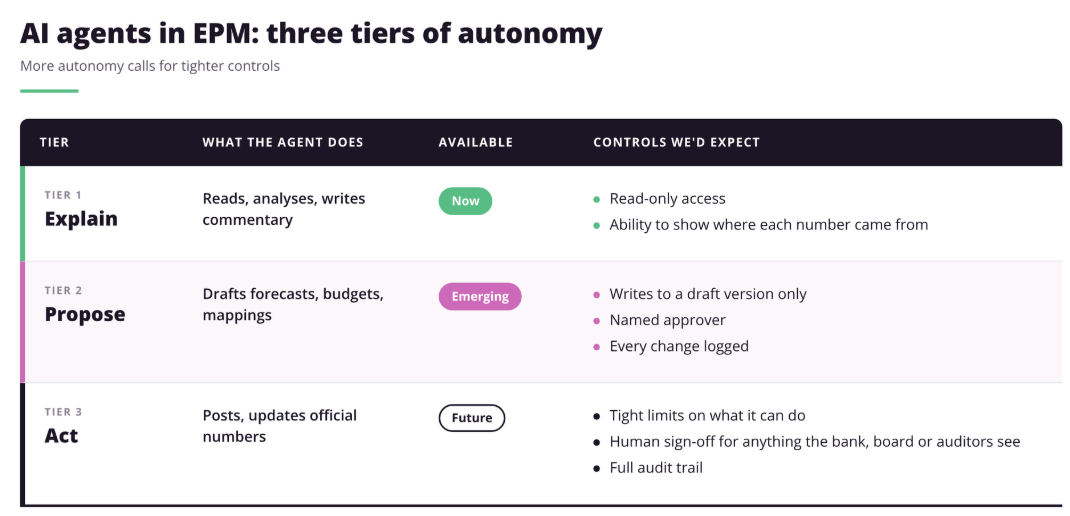
Permissions, validation, exception handling and audit trails shouldn't be afterthoughts. They need to be part of the design from the start.
5. The decisions you make today shape what AI can do tomorrow
One of the biggest benefits of the new features of AI is that you don't need to redesign every finance system. However, you do need to make better structural decisions whenever the chance comes up – and you should be starting this now.
Adding a product field? Check whether the old account structure can be simplified at the same time.
Considering allocations for Profitability? Does this need to live in your ERP, or is it better surfaced as a reporting output
Redesigning a reporting process? Ask whether the logic is documented and repeatable without relying on one person's memory. Are the exceptions still required?
Implementing a new planning or ERP system? Review whether financial definitions and rules are consistent across systems and simplify until they are.
These changes pay off now, however fast AI arrives, and honestly make things easier for your human users as well. We've seen clients with one well-structured plan bring a newly acquired business rapidly into it with its own secure access, without requiring a rebuild or a new chart of accounts. Good structure is what makes the next change cheap, whether that change is an acquisition, an agent or even a new graduate hire.
The most common mistake we starting to see is using AI to build and rebuild spreadsheet logic faster. It feels like progress – the speed of Claude or ChatGPT’s output is unparalleled. But an AI-built spreadsheet explosion is itself the problem: many files, many versions, many hours, and nobody ending up owning the rules. Instead of building a solution, you've just automated the problem and multiplied the impact

Five questions to ask before your first finance agent
Which numbers do people outside Finance rely on: operations managers, sales leads, your bank, your board, your auditors, your owners?
Does each of those numbers have one definition, one owner and one system of record?
Where do the same codes or accounts mean different things in different parts of the business?
Which business rules live only in a spreadsheet or in someone's head?
For each task you'd give an agent, is it explaining, proposing or acting, and who approves?
If you can't answer the first two quickly, that's where to start.
Even an AI company needs one place its numbers live
One of our clients builds AI solutions for a living, and it's growing fast.
If any business could run its finances on AI alone, it's this one. Instead, it chose a governed planning platform as the home for its forecast. It wanted one version of the forecast, actuals lined up against budget automatically, and business leads entering their own numbers. Its people build AI for clients. They didn't want to build and maintain a finance system for themselves.
They use AI to build forecasts, model plans and write commentary. The platform holds the official numbers. AI works on top of it, not instead of it.
At Pivot2, we believe the most valuable AI conversations start with how a business's financial information is structured, governed and used.
Because the question isn't whether your finance system can connect to an AI agent. It's whether that agent can understand what it's looking at, and knows what it's allowed to do next.
Let AI think with your numbers. Give it one governed place where the numbers live.